




You are viewing 1 of your 2 free articles
‘Turn up and go’ ambition for Eurostar as London St Pancras bids to emulate London City airport

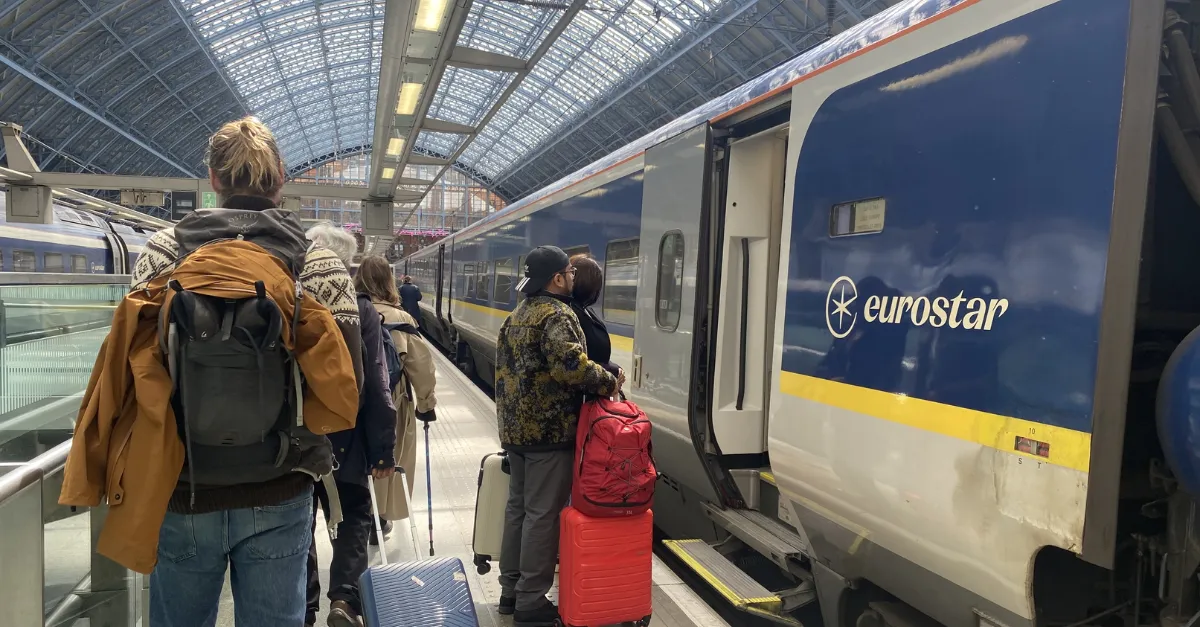
Up to £100 million is to be spent to cut waiting times for Eurostar trains at London St Pancras in a project designed to emulate a “turn up and go” experience offered by London City airport.
London St Pancras Highspeed, the company that operates the station and train line that connects with the Channel Tunnel, wants to end the long queues and “holding pen” experience for passengers in an effort to encourage more people to travel by high speed train to continental Europe.
Company chief executive Robert Sinclair, who previously ran London City airport, told the Financial Times: “The capacity issue is clear to everyone, it is busy at peak [times], the lounge is not big enough, and you have people sitting on the floor, which is unacceptable.
“At the moment, Eurostar asks customers to turn up 60 minutes before departure, sometimes an hour and a half. We both agree that the opportunity is to reduce that down to 15 minutes. We want it to be a ‘turn up and go’ service.”
London St Pancras Highspeed and Eurostar agreed a three-stage collaboration, initially to improve the security and border processes at the international rail hub to increase throughput by 2,700 passengers an hour.
A second phase due for completion in 2028 would see improvements to the international area and its connection to the main concourse to help with passenger flow.
Further exploration of long-term opportunities to drive growth and enhance capacity then will take place.
The entire process should be completed before Virgin Trains starts its Channel Tunnel service at the end of the decade.
“We can complete this in four years. We will ensure we have capacity in place [before Virgin arrives],” Sinclair said. “We’re not building a new railway station here.”
The overhaul will involve turning the current queue lines sideways and extending them into an “empty arrivals hall”. That would allow for double the number of passenger security checks, helping the overall queue times to be shortened, in a similar approach used during security checks by some airports, the FT reported.
Sinclair said: “The speed of process is much faster in the airports than what we have in St Pancras, where we have short lanes that are highly congested.
“We have taken a leaf out of London City where you can turn up and go through very quickly. A bad outcome at London City is 10 minutes. If we offer that same level of consistency, then people over time will begin to rely on it.”
Such a change would also allow passengers to board trains earlier, up to half an hour before departure instead of the current 10 to 15 minutes.
“The whole idea is not to hold people in a pen in a departure lounge,” Sinclair added. “If people turn up earlier, they can have a coffee in one of our coffee shops in St Pancras, and then wait to go through.”
“If they get there with only 30 minutes to go, they can go straight through and sit on the train. The train and carriages are effectively a boarding gate. We don’t plan to fill that departure lounge with retail; what we want is more passengers.”
Virgin this year won access to the Temple Mills rail depot, which will allow it to service cross-channel trains and begin offering an international service from London.
Eurostar has also outlined ambitions to extend its network, with routes to Cologne, Frankfurt and Geneva, and has an order for up to 50 trains.
Sinclair said St Pancras had ample capacity for both operators to run, with the main congestion being the security and departure areas.
Reducing queue times would help increase the appeal of rail travel to Europe, which he believed would win over environmentally conscious passengers who did not want to fly.













More Content







Jacobs Media is a company registered in England and Wales, company number 08713328. 3rd Floor, 52 Grosvenor Gardens, London SW1W 0AU
© 2025 Jacobs Media
