



You are viewing 1 of your 2 free articles
Norse Atlantic hails ‘new chapter’ with move into profit

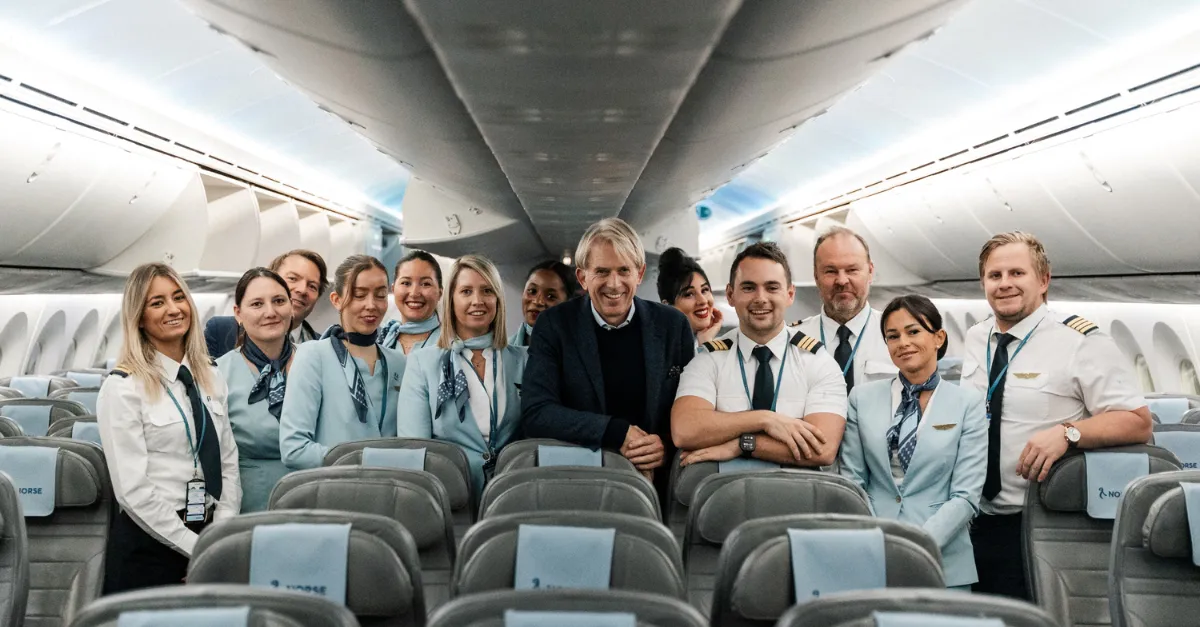
Norse Atlantic Airways reported a move into profit last year after splitting its fleet between in-house flying and external leases.
Earnings before interest, taxes, depreciation, amortization and rent (Ebitdar) of $56.5 million was reported from a loss of $858,000 in 2024 as fourth quarter revenue grew 25% year on year.
The long-haul low cost carrier expects to report an ebitdar in the range of $130-150 million in 2026 and a pre-tax profit in the range of $20-$40 million.
This year’s outlook reflects the planned flight programme, ticket sales to date, “continuous optimisation of pricing and load” in its own network together with “ongoing and new cost initiatives” and estimated fuel costs.
“The shift to a balanced dual ACMI (wet lease) and own network model was successfully completed in January, supporting sustained margin expansion on a low-cost platform with a balanced risk profile,” the airline noted.
Norse has aircraft operating for Indian airline IndiGo and P&O Cruises to fly passengers to join ships in the Caribbean in winter.
The airline operates a fleet of 12 Boeing 787 Dreamliners carrying 338-passenger in a two-class configuration covering destinations across North America, Europe, Africa and Asia, including a base at Gatwick.
Norse Atlantic reported a total of 4.7 million passengers flown since its first flight in June 2022.
Newly-installed chief executive Eivind Roald, a previous chief commercial officer at Scandinavan airline SAS, said: “2026 marks a new chapter for Norse Atlantic with the completion of the transition to a balanced dual ACMI and own network model with reduced risk, more stable revenue, higher flexibility and increased exposure to high-demand routes.
“Our ambition is clear: to provide a market-leading affordable long-haul travel product. A great customer experience is the foundation for delivering strong margin expansion on our low-cost platform with a balanced risk profile and accelerating shareholder value creation.
“Since becoming CEO in late November, my focus has been on implementing the new business model and on operational simplification to improve speed and responsiveness to market demand. This includes adjusting our network design to better handle irregularities and investing in technology and capabilities to efficiently deliver more consistent customer experience.”
He pointed to “decisive steps” made to create a more focused own network targeting long-haul routes with strong demand and high fare potential.
“The winter sun programme between Europe and Asia and Africa illustrates this disciplined network high-grading strategy,” Roald noted.
“The early results are encouraging. In December, we had a 6% increase in network unit revenue (TRASK) and a 14% increase in production (ASK) compared to the same month a year ago, reflecting higher ticket prices and cargo revenue. The momentum in January is even stronger with a 21% year-on-year increase in unit revenue and 23% increase in production, and we see the positive trend continuing through February.”
He added: “Norse has a solid foundation for success with highly favourable long-term aircraft leases, an attractive product yielding 96% load factor for 2025 and high customer ratings for our service-minded crew.
“The strong improvements in recent months confirm that people are willing to pay more for our product on the right routes.
“Our low-cost operations control centre in Riga is ready to scale as we optimise the route mix for higher profitability.
“The winter programme to Thailand is a great example of how this high grading creates value. We will accelerate commercial efforts to increase prices and ancillary revenue, while also maximising our cargo potential.”
The airline has taken measures to balance aircraft utilisation to “increase predictability and avoid unnecessary cancellations” due to maintenance requirements.
“We aim to become significantly more efficient in customer handling when such irregularities occur,” Roald pledged.
“This is part of redefining Norse as an ‘airline on demand’, responding more quickly to changes in market trends and demand.
“We will be flexible and offer charters/ACMI if that is the most profitable option, we will open and close routes more quickly to maximise profitability. Further we are strengthening our brand and product positioning to increase our total yield as part of our intensified focus on revenue management.”
Related Content















Jacobs Media is a company registered in England and Wales, company number 08713328. 3rd Floor, 52 Grosvenor Gardens, London SW1W 0AU
© 2025 Jacobs Media
