




You are viewing 1 of your 2 free articles
Passengers at European airports rise by 100m to set new annual record

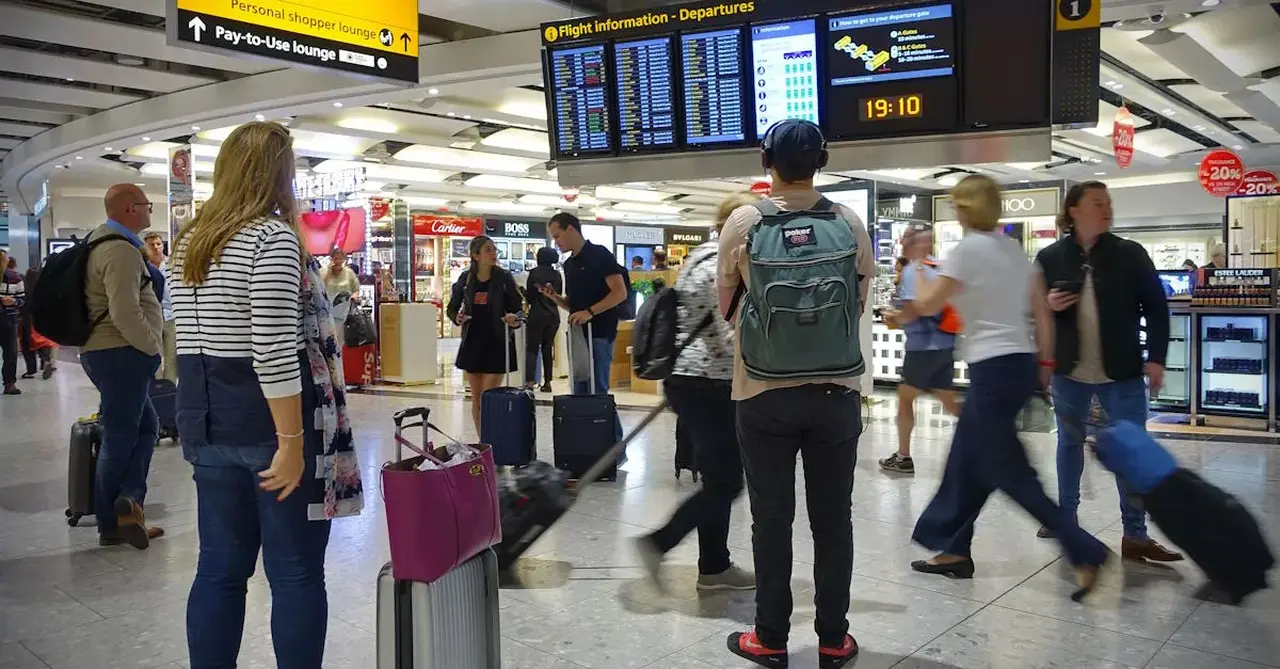
Europe’s airports handled an additional 100 million passengers last year and set a new record of 2.6 billion travellers, new figures show.
Passenger traffic across the European airport network in 2025 rose by 4.4% year on year – marking a return to “normalised” growth patterns after the bounce back from the Covid-19 pandemic, according to trade body ACI Europe.
The organisation hailed the “remarkable resilience” of air passenger traffic amid “generally lacklustre European economies, inflated airfares, significant supply and capacity pressures, as well as ever volatile and tense geopolitics”.
Heathrow retained its position as Europe’s busiest airport in 2025, welcoming 84.48 million passengers – an increase of 0.7% over the preceding year thanks to airlines operating larger aircraft into the capacity-constrained London hub.
Close behind came Istanbul with a 5.5% rise in passenger traffic, coming short of Heathrow by just 40,000 passengers with a total of 84.44 million.
Passenger numbers at the Turkish hub have grown by almost a quarter over the past five years.
Istanbul’s Sabiha Gokcen airport saw passenger traffic increase by 16.7% last year to 48.41 million.
Paris-CDG was Europe’s third busiest airport with 72.02 million passengers – an increase of 2.5% over 2024.
Amsterdam-Schiphol came in fourth with an increase of 2.9% to 68.77 million passengers. The Dutch hub was closely followed by Madrid with 68.12 million passengers and a 3% increase.
Overall passenger traffic remained on a positive trajectory throughout 2025 with the growth “dynamic accelerating” by 6.1% in the final quarter of the year, seen as a “positive signal” for 2026.
The growth was entirely driven by international passenger traffic which expanded by 5.6%, while domestic levels remained flat at 0.2%.
While many European airports broke their passenger traffic records, 41% of them finished the year still below their pre-pandemic 2019 levels as traffic performance variations “remained a reality”.
“This reflects increased traffic volatility, airline dominance and consolidation along with renewed competitive pressures upon airports,”ACI Europe noted.
Director general Olivier Jankovec said: “If anything, last year’s traffic performance is yet another proof that air connectivity is a powerful and largely resilient economic driver, increasingly intertwined with tourism.
“This reflects the rise of experiential consumption over material consumption – a deep‑seated cross-generational structural shift that is reshaping our economies, and for which Europe is uniquely well positioned.
“This means aviation is a critical enabler of competitiveness. Yet too many governments and policy makers still fail to connect the dots, and do not treat aviation as the strategic asset it is – especially in the EU.”
He forecast that growth is expected to normalise this year to a level of around 3.3%.
“Upside potential stems from modestly improving European economic prospects, while travel remains among consumers’ top discretionary spending priorities – even as geopolitics and geoeconomics are likely to further test the sector’s resilience,” Jankovec added.
“Many airports are also likely to benefit from Europeans being more prone to travel within Europe rather than externally, while our continent will remain a destination of choice for non–Europeans.
“Meanwhile, Europe’s airlines are projected to deliver the strongest financial performance globally, and the supply chain pressures constraining their capacity deployment are expected to somewhat ease.
“However, infrastructure capacity both on the ground and in the air will remain a key bottleneck. We are especially concerned with the full rollout of the Schengen Entry/Exit System as of April.”













Related Content







Jacobs Media is a company registered in England and Wales, company number 08713328. 3rd Floor, 52 Grosvenor Gardens, London SW1W 0AU
© 2025 Jacobs Media
