




You are viewing 1 of your 2 free articles
The Interview: Tui Group sustainability chief Melvin Mak
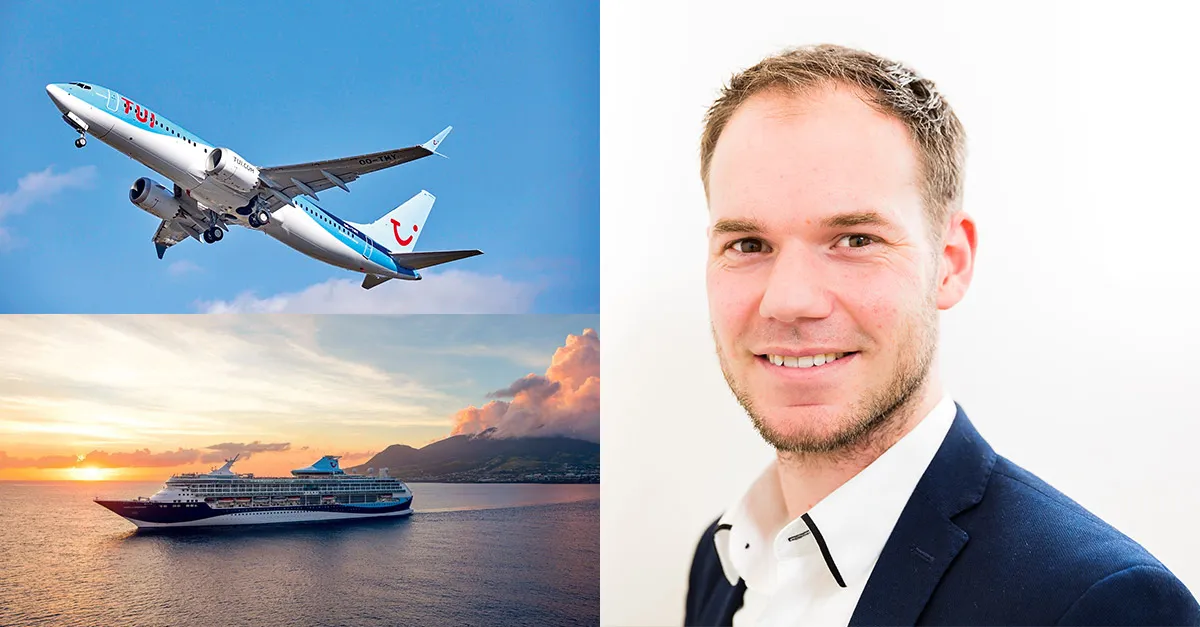
Operator’s ESG director tells Samantha Mayling how the company is ‘making good progress’

From aircraft and cruise ship emissions to buffets and microplastics, there’s plenty to tackle in Melvin Mak’s in-tray.
He was appointed as Tui’s group director for sustainability and ESG in November, with a remit to advance the group’s ‘People, Planet, Progress’ sustainability agenda. Assessing the tourism giant’s achievements as 2025 draws to a close, he says: “We are making good progress again.”
In the drive to reduce carbon emissions, he’s guided by the Science Based Targets Initiative (SBTi) and roadmaps for Tui’s airline, cruise and hotel operations that are in line with Paris Agreement goals.
Compared with 2019, by 2030 Tui aims to have reduced Scope 1 and Scope 3 emissions from airline jet fuel by 24% and from cruise marine fuel by 27.5%, as well as Scope 1 and 2 greenhouse gas emissions from its hotels and resorts by at least 46%.
Taking flight
In the air, sustainable aviation fuels (SAF) and operational efficiencies are the “biggest levers” to cut emissions, he says. The arrival of more Boeing 737 Max aircraft this financial year (the 12 months from October 1) will give Tui “a good start”, he adds, because they make short-haul flight operations more efficient.
In October, Tui’s airline ran a special flight from Gatwick to Cancun to demonstrate its sustainability efforts. The Boeing 787-8 Dreamliner service showcased the carrier’s commitment to fuel efficiency, cabin waste reduction and “collaborative innovation”.
During November, several Tuifly passenger flights were followed by a research aircraft from the German Aerospace Centre to investigate climate-impacting contrails. This provided real-time data about condensation trails produced by aircraft engines – and measurements can show how much new engine technologies can reduce this effect.
Cruise technology
Technological innovation is also key to cutting cruise emissions, he says, pointing to renewable fuels and ship‑to-shore power developments.
In July, Mein Schiff Relax, the newest member of the fleet, was supplied with bio-LNG for the first time as part of a so-called ship-to‑ship bunkering operation via a barge in Barcelona. Bio-LNG is renewable fuel produced from organic waste and can reduce greenhouse gas emissions by 70-100%.
“As we learn about these types of fuels, we can scale that in years to come,” says Mak. “Tui Cruises operates one of the youngest fleets in the world and, with that, comes efficiency.
“The flexibility of the newest technology is crucial; if we only operate ships that don’t use different or newer fuels, then emission reduction becomes more challenging.
“Shore power is a big thing – the ports are doing a good job making that available.”
Hotel innovation
Turning his attention to Tui Hotels & Resorts, Mak says: “The biggest topic within emission reduction in hotels is energy and fuel, so renewable energy is a big thing for our properties.
“We’re working with hoteliers to scale up PV [photovoltaic] technology on hotel rooftops and large-scale facilities in destinations.”
He says one of the “biggest achievements” is the development of solar-power plants in Turkey, which supply clean electricity to eight hotels year-round.
A fourth plant has just been installed, with the fifth and sixth in development.
“In my 14 years at Tui, I’ve never seen us at the forefront of a PV development as large as this; it’s a great example of how we make big steps in renewable energy.”
Technology is also helping food management in hotels, such as AI trials to tackle wastage – and some waste that can’t be avoided can be turned into biogas or fertiliser.
Connecting hotels to local communities is another strategy, exemplified by Tui’s Field to Fork programme. It supports sustainable and regenerative practices which maintain biodiversity and produce local delicacies – and creates short supply chains.
Mak highlights how the concept is now in several destinations, from Rhodes and Cyprus to Portugal, Italy, Cape Verde, Tanzania and Colombia.
Tui also has a Green & Fair portfolio of hotels that are committed to supporting local communities and looking after the environment – and are certified by the Global Sustainable Tourism Council.
Guests’ travel to and from hotels is another part of the sustainability strategy, with targets such as e-charging stations at 1,000 hotel locations by 2030.
By the same year, Tui aims for about 90% of employee service vehicles, 90% of vehicles used in operations and 80%–90% of all guest transfers to be electric.
Tackling plastics
“Since 2022, Tui has reduced the amount of single-use plastic in our hotels by about 19% per guest night,” says Mak. “We focus on avoiding, reusing or replacing plastics wherever we can.”
He highlights the balancing act of cutting out plastics, such as stirrers and straws, which doesn’t generate negative guest feedback, with removing items that holidaymakers do expect, such as containers for sauces at buffets, in which case, another option is sought.
“If we explain it well…guests appreciate changes,” he adds.
Other initiatives have seen the installation of water refill stations, to reduce the need for plastic bottles, plus plastic-free amenities in bathrooms.
“We’re making good progress. It does not cause any negative influence on guest experience; it is a win-win situation.”
Some hotels are also installing microfibre filters in their laundries, following their introduction on cruise ships, to tackle microplastic pollution.
In partnership with the Cleaner Seas Group, the aim is to prevent microplastics released during laundering from entering the sea and threatening marine biodiversity and human health.
“The filter system can capture up to 99% of microfibres,” says Mak.
“We have currently installed their technology at the two Robinson clubs in the Maldives and are in talks about which hotels should be next.”
Communication
Asked how agents can help Tui’s sustainability drive, Mak recalls how he started in the sector as an agent.
“We need to understand better how we get the message across,” he says. “There’s a responsibility on our side to ensure hotel operations and our supply chains are managed well.
“People don’t deliberately book a specific holiday because a hotel has plastic-free amenities. Customers expect us to deliver on these areas, and be a responsible business.
“Cases where people deliberately ask for a sustainable holiday are fairly limited. Even if customers don’t explicitly ask for a more sustainable holiday, that doesn’t mean that we don’t have the responsibility to deliver it – we still have a corporate responsibility to ensure that we reduce our emissions in aviation, run our hotels on renewable energy, and reduce plastics.”
He says “loads of stories” resonate well with holidaymakers, adding: “We need to really understand the key elements that we can give to travel agents [and] to customers.”
Mak notes how customer ratings on Tui Musement’s range of more than 40 National Geographic day tours are higher than the group’s average.
“There’s a huge focus on experiencing things in a more responsible way – on exploring local culture and foods,” he says.
“We need to explore how we can upscale that to ensure guests really experience the local destination, nature, cultures – and we respect the destination and communities.”
Tui’s agents can learn about sustainability via webinars and the group’s Sustainability Academy, which includes an extensive climate module.
Mak also urged agents in the UK to take a Tui flight, and stay in a Tui hotel or cruise, to see its sustainability credentials themselves.
“We don’t see sustainability as having a final destination somewhere in the future; for us, it’s a journey that we have embarked on and we have commitments for continuous development,” he adds.
“We want to showcase leadership in the tourism industry. There’s a lot on our desk, as there is for any travel company.
“There are new technologies and initiatives that we jump on, to continue making that journey successful, and there should be lots of collaboration, so businesses don’t reinvent the wheel all the time.
“How do we ensure – as an industry, not just Tui – that the destinations that we visit today are still beautiful years from now?”
Related Content










Related Content






Jacobs Media is a company registered in England and Wales, company number 08713328. 3rd Floor, 52 Grosvenor Gardens, London SW1W 0AU
© 2025 Jacobs Media
