




You are viewing 1 of your 2 free articles
Small-ship cruise lines ‘should focus on product, not price’

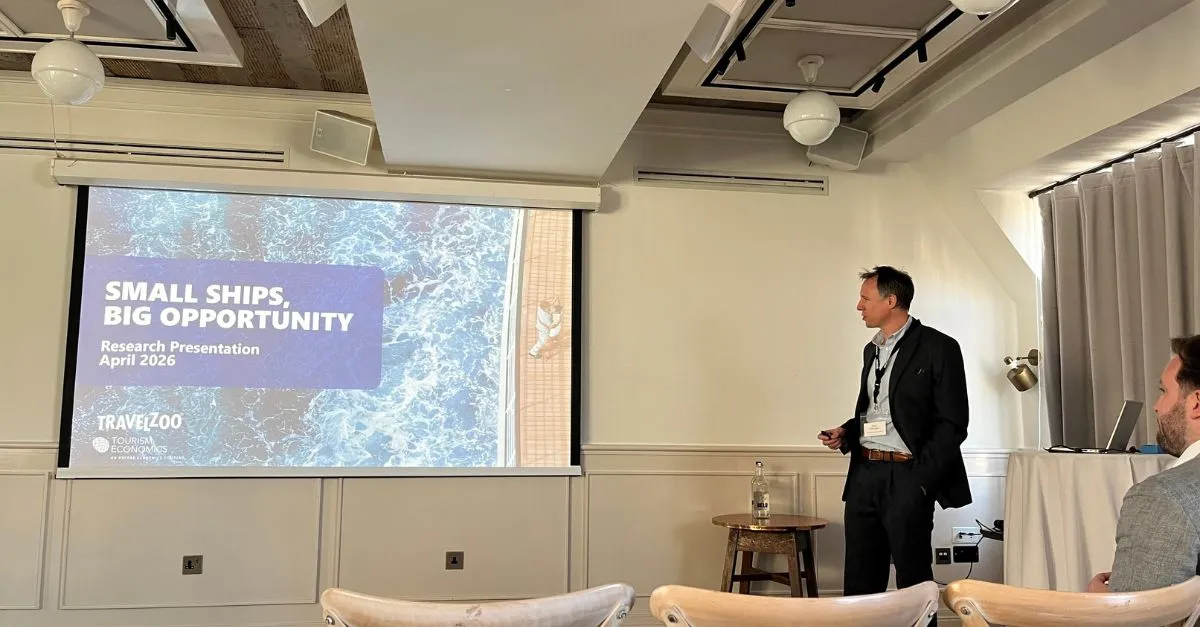
Small-ship cruise lines, across luxury, river and expedition, should focus on transparency and innovating their product to reach those yet to try the sector, according to new research commissioned by Travelzoo.
A survey of 6,000 consumers interested in cruise found there were “increasing” opportunities in the small-ship sector, defined as vessels with fewer than a thousand passengers, as capacity is forecast to outpace the wider cruise industry.
Speaking at a Travelzoo event in London, Sean Morgan, head of travel industry research at Tourism Economics, told attendees pricing was “not the be all and end all”, especially once people had tried a small-ship cruise, but revealed perception of the high cost was one of the biggest barriers to people trying it for the first time.
He said: “For people that are perhaps less familiar with a cruising experience, and particularly a small-ship cruising experience, it’s a bit of a black box, so transparency regarding what is included can be a very important way of understanding how value can be associated with cost.”
Morgan added there was “an opportunity” for small-ship lines to prioritise innovating their product, including itineraries, enrichment, facilities, food, drink and service, and “using less bandwidth to tactically price in the short-term view”.
He said small-ship cruise lines were expected to go to “unspoiled places” that more mainstream lines do not, with a significant growth in interest in “alternative destinations”.
The survey by Tourism Economics was conducted with consumers from across the UK, US, Canada and Germany.
Nearly half of UK consumers polled (48% of 1,508 people) had previously taken a small-ship cruise and had the joint highest mean number of overall cruises per year out of all of the nationalities included (4.6).
“It is very clear in the data that through increased familiarity, knowledge and understanding of the sector, it does equate to increased interest and conversions,” Morgan said..
The average age of a small-ship cruiser in the UK was 53 years old and empty nesters and couples were “critical parts” of the audience, with the family market increasingly interacting with the sector.
Among those that said they were not interested in taking a small-ship cruise in the future, which equated to 15% of respondents, the biggest barriers to trying it out for the first time was the perceived high prices, lower range of facilities than a larger ship and health and physical fitness needed to participate, which Morgan said could be “tackled through communications and messaging”.
In a sector-wide overview, he added: “From 2026 through to 2030, we are anticipating capacity growth [in luxury] of 4.7% which compared to the industry-wide growth of under 3.5% means when you actually do the comparison, the growth rate [in luxury] is accelerating 30% faster than the industry.”
He added capacity in the luxury cruise market had nearly doubled (91%) in the last 10 years and was set to increase by nearly a third (31%) in the next decade, outstripping industry-wide growth.
He said there was “a real scope of opportunity within small-ship cruising”, especially in markets with higher-than-average travel expenditure and previous experience of cruising.
In the research company’s survey on cruise preferences in December, Morgan said more than half of the sample of recent cruisers (exceeding 2,500 people), said they were “more interested” in premium or luxury cruise experiences compared with two years ago.
“We are living in an environment where the experience economy is gaining significant traction,” he said. “People are prioritising experiences over materialistic goods and this is a well-established trend that seems to be accelerating.”
Morgan said this was true of both emerging and advanced economies where the available income allocated towards travel by consumers is increasing.
Related Content







More Content





Jacobs Media is a company registered in England and Wales, company number 08713328. 3rd Floor, 52 Grosvenor Gardens, London SW1W 0AU
© 2025 Jacobs Media
